

When Cynthia’s sister delivered a premature baby years earlier, it planted a quiet instinct that never quite left her. So when she became pregnant, she chose to deliver at McMaster Children’s Hospital (MCH). “I just felt like that was the better hospital for our family to have a baby,” she recalls. Her intuition was correct.
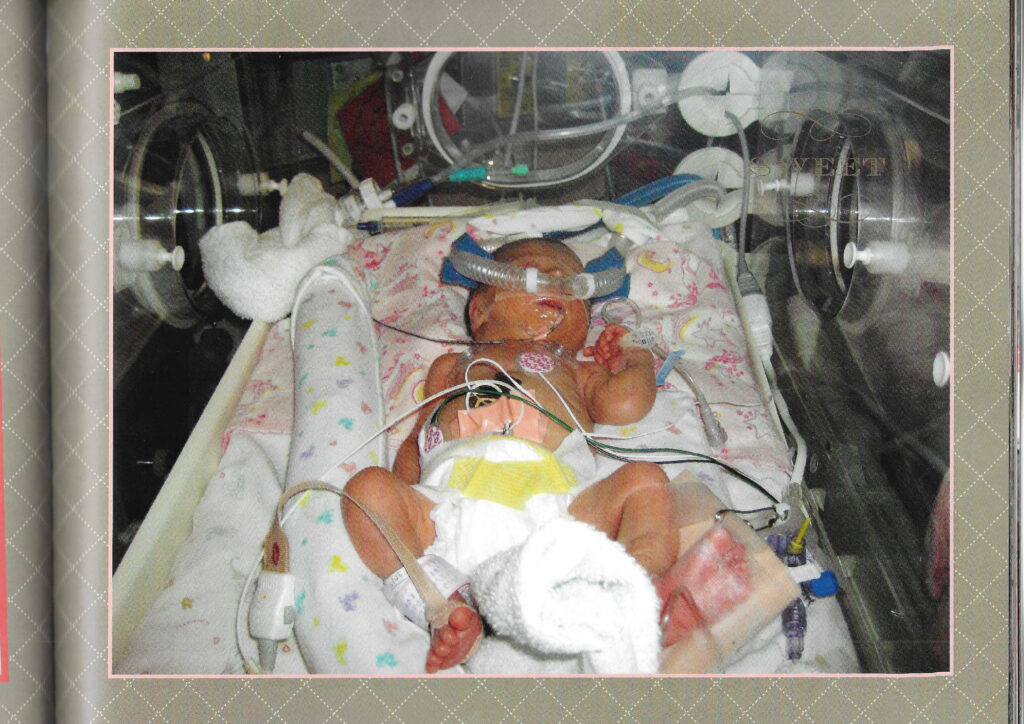
At just 30 weeks pregnant, her daughter Maia decided that, ready or not, she wanted to greet the world. Maia’s tiny body – just three pounds, one ounce – wasn’t ready, but the team at MCH was. From her very first hours, exceptional health care workers in the hospital’s neonatal intensive care unit (NICU) and advanced, donor-funded equipment sustained her. A CPAP machine supported her breathing, an incubator regulated her temperature and monitors continuously tracked her every vital sign.
When Maia’s condition suddenly worsened on day two, the team moved quickly: a chest tube relieved the pressure in her chest from a collapsed lung, surfactant therapy helped her lungs expand and a ventilator took over her breathing entirely. Each piece of equipment, each life-saving intervention, was there because of donor support.
In the days that followed, Maia’s care team responded to each new challenge as it arose. Jaundice was treated with phototherapy. A blood infection was managed with targeted antibiotics and multiple platelet transfusions. The care team also closely monitored her heart conditions, her brain to check for any bleeding, and her eyes to screen for retinopathy of prematurity. It was an emotional roller-coaster, but Cynthia and her family were never alone. She shared: “They were always keeping us informed, step-by-step, offering support and reassurance.”

MCH is one of Canada’s largest pediatric academic teaching hospitals and the regional hub for children’s care across south-central Ontario, serving more than 80,000 patients each year. Its neonatal intensive care unit (NICU) is the largest in Canada and provides life-saving care to the most fragile newborns. For Cynthia, that depth of expertise was everything. “I always felt that I was in the best place. I had a lot of confidence in the technology because it was a research hospital and that was important to me.”
At three weeks old, Maia was stable enough to transfer to her community hospital to grow and gain weight. For Cynthia and her family, leaving MCH was difficult. “That was a moment when our family had a lot of anxiety because we felt so comfortable with the level of care at McMaster [Children’s Hospital],” Cynthia says. “You just don’t think any other hospital is going to match it.”
However, Maia’s care at MCH didn’t end at discharge. While she was under the care of her local hospital, Maia was transported for visits to MCH’s specialized eye clinic, where she was monitored for eye disease that can affect premature infants, a reflection of the kind of coordinated, continuous care that only a regional centre can provide.
After eight weeks in hospital, Maia came home, small but strong, weighing five pounds, 12 ounces. Her relationship with MCH continued well beyond that day. For years afterward, the Growth and Development Clinic and the hospital’s ophthalmology clinic closely followed her progress. She met every milestone.
Today, Maia is 17-years old and thriving. She excels academically, leads in student council, enjoys dance – especially ballet and pointe, varsity volleyball, snowboarding, and works as a lifeguard and swim instructor. She is now setting her sights on university. That journey from a ventilator in the NICU to a teenager who fills every room she enters is proof of what extraordinary care – supported by extraordinary donors – makes possible.