

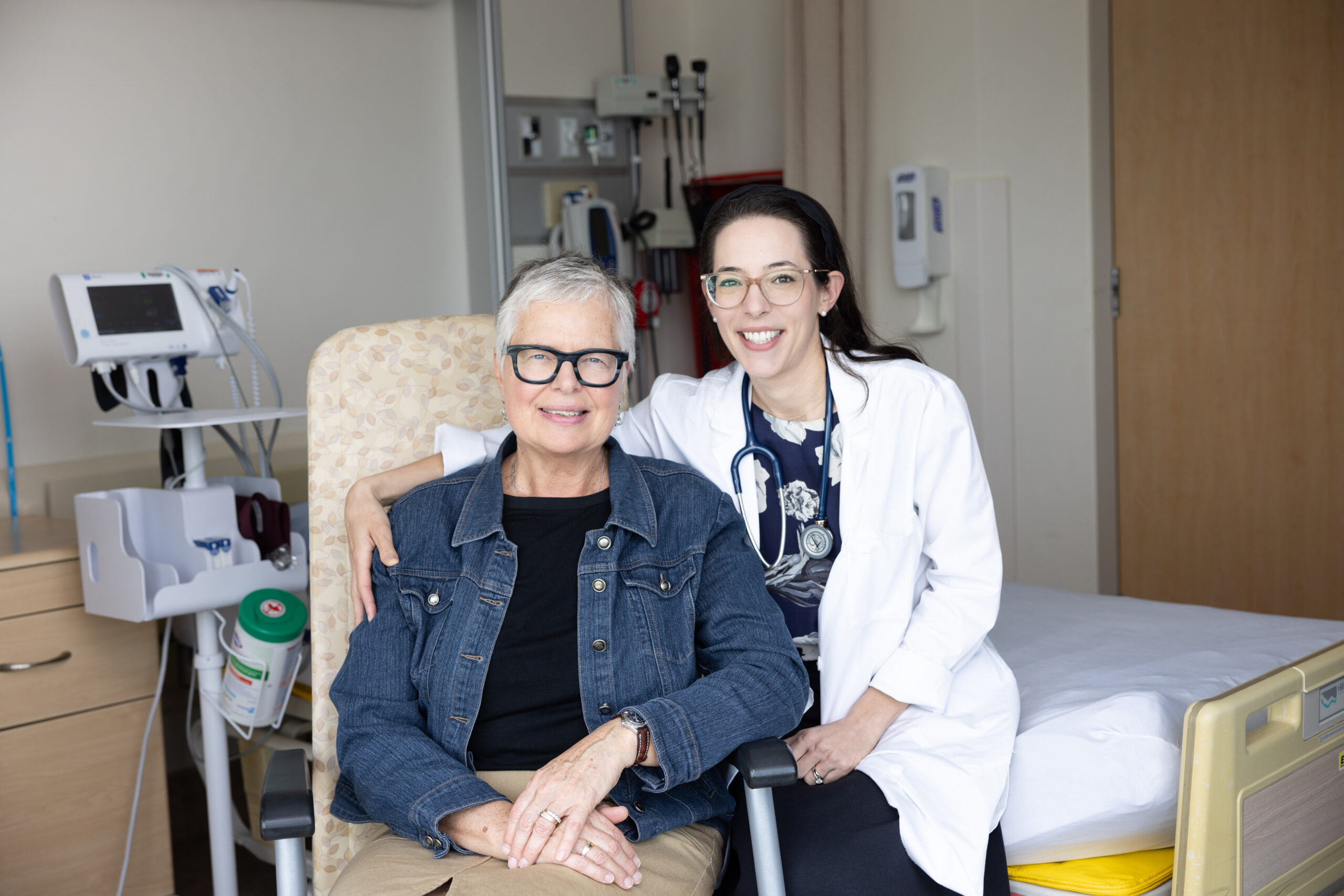

When Kate was just three weeks old, a routine checkup with her family doctor revealed that she wasn’t gaining weight. The doctor acted quickly, sending Kate to McMaster Children’s Hospital where she was diagnosed with adrenal insufficiency. That referral saved her life.
Kate was diagnosed with adrenal insufficiency – a condition that prevents the body from producing enough cortisol to respond to physical stress. Without treatment, even a cold or stomach flu could trigger life-threatening complications. The care team began the complex work of stabilizing Kate’s health and building a medication plan that would help her body do what it couldn’t on its own.
“When we got sent home, I felt like they prepared me as much as they could,” says Kate’s mother, Melanie.
The team trained Kate’s parents to give medication to a newborn four times a day and use an emergency injection if needed. They also offered 24/7 access to a pediatric endocrinologist, providing expert guidance and reassurance whenever it was needed.
Kate’s early years involved dozens of visits to the hospital, including multiple emergencies. “That was really scary,” says Melanie. “But once we got there, the hospital staff were very helpful. They took us very seriously.”
The emergency team was always prepared when Kate arrived. In addition to urgent care, her condition required ongoing monitoring, blood work and appointments with a range of specialists. Her care included endocrinology, genetic testing and child life support. Having all the expertise in one place made a complex condition more manageable.
Kate quickly built relationships with the team. She grew so comfortable that, by the time she was a toddler, she would walk into the lab, say hello to the technicians, and extend her arm for blood work without fuss. As she grew, child life specialists helped her build confidence in managing her care—teaching her how to speak up about her needs and make sure others knew how to support her.
Today, Kate visits the hospital three times a year for routine care. Her daily life still includes medication, and her family remains cautious around illness. While a mild cold once meant a hospital stay, they can now often manage minor illnesses at home.
McMaster Children’s Hospital continues to grow with Kate. When her longtime doctor moved to a different hospital, her new physician ran updated tests, reviewed her history, and ensured a smooth transition. “We felt instantly at ease,” says Melanie. “She was extraordinarily knowledgeable.”
Now a bright and energetic teenager, Kate enjoys horseback riding, soccer, piano and time with her friends. She keeps busy with school, sports, and a part-time job at a local café. “She’s this perfect combination of kindness and responsibility and vibrancy,” says Melanie.
Behind Kate’s story is a network of donor support. From specialized equipment and child life programming to expert training, donations help ensure families like Kate’s have access to every resource they need.
“It’s a pretty amazing person who donates,” says Kate. “The impact is immeasurable,” Melanie agrees. “I hope everybody does this because we’ve experienced the massive benefits McMaster Children’s Hospital has provided. I hope everybody supports it because it truly changes lives.”
Experience a true Black-Tie Vegas-Style Fight Night as local business pros step into the ring as Champions for Charity in support of MacKids. The evening begins with a lively reception, live entertainment and an exquisite three-course dinner by the award-winning Tapestry Hall. Then, eight sanctioned bouts deliver edge-of-your-seat action for a worthy cause.
A generous gift from a long-time donor is bringing more world-class cancer detection and treatment technology to south-central Ontario, giving patients and their families new hope.
The Ron and Nancy Clark Foundation’s $1,395,000 gift will benefit two priority initiatives: a new Positron Emission Tomography/Computed Tomography (PET/CT) scanner, and magnetic seed therapy equipment at Juravinski Hospital and Cancer Centre (JHCC).
For over 60 years, the Caledonia-based foundation has advanced health care in south-central Ontario — supporting Hamilton Health Sciences since 2012 with more than $8.6 million enabling many priority projects including the build of the Ron and Nancy Clark Stem Cell Transplantation and Cellular Therapies Unit at JHCC. Supporting Hamilton Health Sciences has been extremely important to the Foundation, as cancer patients from the Caledonia/Haldimand community are commonly referred to Juravinski Hospital and Cancer Centre for care.
“The Foundation believes that giving back to health care is one of the most meaningful ways to support our community. For over a decade, we have been thrilled to see the impact of our partnership with Hamilton Health Sciences, demonstrating time and time again what can be achieved when we work together to build a brighter future for patients and their families.”
– The Ron and Nancy Clark Foundation
Accelerating Answers with PET/CT
Early and accurate diagnosis is critical for effective cancer treatment. Thanks to this gift, health care teams at JHCC will have access to one of the most powerful tools in modern cancer care: the PET/CT scanner. This advanced imaging system provides a detailed, real-time view of cancer activity in the body. It allows oncologists to locate tumors with greater precision, and gather the exact information needed to create personalized treatment plans. For patients, this means a faster path to the right treatment and better outcomes.
“The PET/CT scanner is transformative in how we diagnose and monitor cancer. It allows us to see not just where cancer is, but how it’s behaving. This will enable our clinicians to make faster, more accurate decisions and deliver the most effective, individualized care possible.”
– Dr. Chris Hillis, Chief of Oncology, Juravinski Hospital and Cancer Centre
Making Breast Surgery Safer and More Precise
The Ron and Nancy Clark Foundation’s contribution is also advancing care for patients managing a breast cancer diagnosis. The introduction of magnetic seed therapy is making breast cancer surgery safer, more comfortable, and more efficient. This innovative technique replaces the need for older, radioactive methods of tumor localization. Surgeons can now insert a tiny, non-radioactive magnetic seed to mark a tumor’s location. Using a handheld probe, they can guide the procedure with extreme accuracy, ensuring the complete removal of cancerous tissue while preserving as much healthy tissue as possible. This technology reduces the number of procedures a patient may need and improves their overall experience.
“The support of strong partners like the Ron and Nancy Clark Foundation is so important to bringing to life the innovative treatments and therapies that make meaningful change in the lives of patients.”
– Anissa Hilborn, CEO, Hamilton Health Sciences Foundation
A Legacy of Transformative Giving
The ongoing generosity of the Ron and Nancy Clark Foundation brings more than just leading-edge equipment and resources to JHCC. It brings hope to patients and peace of mind to their families. Their visionary support ensures clinical specialist teams have the cutting-edge tools they need to provide the best possible care. This enduring partnership is a powerful example of how community-focused philanthropy directly improves and saves lives.
Life with Parahemophilia
Every week, 12-year-old Karina arrives at McMaster Children’s Hospital for her treatment. She rolls up her sleeve, chooses which arm to use and which band aid she’ll want, and confidently engages with her care team. She’s been doing this for nearly her entire life.
Karina was just days old when her parents learned she had Parahemophilia, also known as a factor V deficiency, a rare and severe bleeding disorder. After a routine heel prick wouldn’t stop bleeding, her local hospital in Niagara quickly referred her to McMaster Children’s Hospital, where specialized testing confirmed the diagnosis.
A Second Home at McMaster Children’s Hospital
McMaster Children’s Hospital became a second home to Karina and her family. It offered expert care and a place where they could learn and feel supported. “It’s a safe place,” says Karina. “It’s like they’re part of my family.”
McMaster Children’s Hospital is a regional hub for complex pediatric care, meaning families like Karina’s can access the expertise they need all in one place. For children with rare conditions, that proximity can be life-changing.
Parahemophilia affects the blood’s ability to clot, which means that even minor injuries can cause prolonged or spontaneous internal bleeding. Because of her condition, even minor bumps or falls can lead to serious internal bleeds, especially in her joints.
Karina’s treatment includes weekly plasma infusions to replace what her body cannot produce on its own. These hospital visits are essential: there is no take-home version of her medicine.
The hospital’s team of hematologists, nurses, and physiotherapists worked closely with the family, ensuring they never had to navigate it all alone. Her mom, Loretta, learned how to monitor for dangerous bleeds, measure swelling, and stay calm in emergency situations. As Karina matured, they helped her understand her own medical needs in ways she could grasp, empowering her to become her own advocate.
“She’s a tough cookie for all the things that she has to go through,” says Loretta. “She does it with lots of resilience and strength, so I’m very proud of how strong she is and how far she’s come.”
Growing Up with Confidence and Support
Now in Grade seven, Karina educates classmates about her condition and confidently explains her treatments to new friends. She’s even brought them along to the hospital to show them what a day in her life looks like.
For Loretta, the difference McMaster Children’s Hospital has made in their lives is clear. She knows that without the generosity of donors, the expert care her daughter relies on might not be so close to home.
“Donations are the reason why kids like Karina can get the support that they need. We have the care closer to home because of those donations. We don’t have to go all the way to Toronto,” says Loretta. “The more money you have to give the hospital, the more they can give back to their patients.”
Chloe is a bright light.
“Anytime you walk into a room, she’s smiling,” says her father, Conrad. “She always tries to spread happiness to everyone.” With her love for volleyball, arts and crafts, dolls, dancing and singing, Chloe radiates joy.
At just four years old, Chloe began showing symptoms that worried her family. “She was wetting herself at recess,” recalls Conrad. In the diabetes research field himself, Chloe’s father had a gut feeling something wasn’t right. A quick test at home on Halloween confirmed it: Chloe’s glucose levels were dangerously high.
They first went to a local hospital, but Conrad left feeling anxious and uninformed. He called a colleague, who urged him to head to a teaching hospital instead. When they arrived at McMaster Children’s Hospital, everything changed.
“The care I received as soon as I got there… wow,” he says. “A nurse and a child life worker met us right at the ER and let us know what’s going on and that everything was going to be OK.”
Dr. Bassilious formally diagnosed Chloe with type 1 diabetes and immediately offered reassurance. “She’s going grow up to be a healthy woman. She’s going have a great quality of life. Don’t worry, everything will be OK,” she told Conrad, her tone, her compassion, instantly putting him at ease.
McMaster Children’s Hospital is one of Canada’s largest pediatric teaching hospitals and serves more than 77,000 patients each year. As a regional hub for children’s care, it provides highly specialized services that make a life-changing difference for families like Chloe’s.
For Chloe, the team’s approach was empowering from the start. “They actually allow Chloe to be part of the care decisions,” says Conrad. “It’s a conversation with me in adult language and then it’s relayed into her language level so she can understand everything.” Appointments begin with questions about Chloe’s wellbeing, before shifting into medical details. “It helps build her self-esteem, gauges her mental well-being and her owning what she has.”
Today, Chloe visits the Child and Youth Clinic every four months for monitoring and support. With every decision, her holistic wellbeing is the focus. For example, Chloe was recommended two wearable medical devices – a continuous glucose monitor (CGM) and an insulin pump – that work together to manage her condition. “It gives us peace of mind,” says Conrad. These devices reduce the number of injections she needs from eight needles daily to just one every three days.
Child Life specialists have been there every step of the way, helping Chloe and her family prepare for future transitions like puberty. They’ve offered guidance on body image and medical devices, helping Chloe feel confident and supported as she navigates this stage of growing up. Additionally, Chloe’s older sister Kaitlyn was offered sessions to help her cope with her sister’s diagnosis and the ever-changing dynamics at home. This quickly became a ‘household’ chronic disease.
Inspired by this support, Chloe has become a passionate advocate. She’s walked the runway in a Diabetes Canada fashion show called Pump Couture, proudly displaying her devices. She’s also offered peer support to other children starting on a CGM.
Conrad credits Chloe’s health and confidence to the comprehensive and child-centered care she has received at McMaster Children’s Hospital. To ensure patients with complex chronic conditions get optimal care, they should go to places like McMaster Children’s Hospital. Taking the time to diagnose, talk, treat and build a relationship is paramount,” says Conrad. “Bundled care makes a world of difference. Anyone who asks me I tell them go to McMaster Children’s Hospital.”
This level of care is only possible thanks to donor support. From emergency care to ongoing clinic visits, donor generosity helps fund essential programs like Child Life, advanced monitoring technologies, and the kind of wraparound care that sees the whole child.
“Even the little arts and craft table helped her take the weight and the burden off what was going on,” says Conrad. “It just allowed her to be a kid.” Whether it’s paint supplies, medical devices, or a reassuring voice, donor generosity helps ensure that children like Chloe receive the exceptional care they deserve today, and for years to come.
We’re turning pain into purpose
That’s how Rosie describes the mission of Isabella’s Warriors, a movement born from the strength and legacy of her daughter, Isabella.
Isabella was a vibrant, funny, and deeply compassionate young woman who left an indelible mark on those around her. She loved to read and dance, had a quick wit, and a knack for delivering dad jokes with perfect timing. She found joy in making others laugh, often at her own expense. “She had a good soul. She was always smiling, always putting others first,” says Rosie.
She was also a dreamer. She had set her sights on teaching English in South Korea and was finishing her certification, saving up, and updating all her health checks to make that happen.
In December 2022, Isabella went for a routine eye exam as part of her preparation to teach abroad. Isabella’s optometrist noticed blood behind her eyes. Often an early sign of diabetes, her doctor ordered blood work. The test results suggested something more alarming than diabetes. On January 23, Isabella received an urgent call while at work that she needed to get to the hospital immediately. Within hours, she was diagnosed with acute lymphoblastic leukemia (ALL), a form of blood cancer, and transferred to Juravinski Hospital and Cancer Centre to begin treatment.
From the moment of her diagnosis, Isabella faced an uphill battle. The treatment plan was grueling. She endured the painful lumbar punctures, the side effects of chemotherapy, multiple bone marrow aspirations and biopsies, a major blood clot in her brain and the endless hospital visits with fierce determination. When she was told she was in remission after the first phase of treatment, there was hope. But then came another blow when doctors discovered a chromosomal abnormality that made relapse almost inevitable. A stem cell transplant would be the best option to prevent the cancer’s return.
It was then that Isabella’s family and friends sprang into action.
“This is the first time for a lot of her friends experiencing somebody so close to them being diagnosed and then having to go through transplant,” remembers Rosie. “But instead of shutting down, they rallied.”
They launched a campaign to support patients just like Isabella by encouraging their networks to donate blood, get on the stem cell donor registry, and donate to support Juravinski Hospital and Cancer Centre. Friends, family, and even strangers stepped up. Isabella’s story spread, inspiring hundreds to take action.
Shortly before Isabella’s transplant, they held a football tournament that raised over $14,000! Then, Isabella’s parents topped up the donation to make it an even $15,000.
On July 20, 2023, Isabella received her stem cell transplant – a day her family called her “rebirthday.” But the journey didn’t get easier. Complications arose almost immediately. The transplant didn’t fully graft, leading to a series of devastating health challenges, including a relentless condition known as graft-versus-host disease (GVHD), which attacked her gastrointestinal system as well as her liver. She endured nine hospital admissions, totaling 188 days, each one more challenging than the last. “The hospital became our home for a long time,” says Rosie. “And the staff became our family.”
Despite her suffering, Isabella remained a fighter. Even when the illness took a toll on her mental health, she pressed forward. She longed for normalcy, for days filled with reading, dancing, laughter, and planning for her future. But the battle was relentless, and on March 14, 2024, Isabella passed away. She was only 23.
Her mother Rosie, father Nick, brother Johnny, and all those who loved Isabella refuse to let her story end in sorrow. They have turned their pain into purpose, carrying forward the mission of Isabella’s Warriors to support those battling cancer. Their most recent undertaking, a golf tournament in 2024 and 2025, raised $9,000 and more than $10,000 respectively. Her dance studio also fundraised and launched a scholarship in her honour. Her light, humour, and kindness remain a guiding force for all who knew her and all who have been inspired to fight in her name.
Play Games and Fundraise to Help Kids on November 8, 2025.
Sign up for Extra LifeLevel up for a cause
When Cody was born, doctors at his local hospital in Cambridge feared the worst. He had Caudal Regression Syndrome, a rare condition affecting about one in 60,000 births. Born without a sacrum and with severely underdeveloped legs and feet, his family was told he likely wouldn’t survive the night. But the outlook changed when he was transferred to McMaster Children’s Hospital.
Today, Cody is 35 and thriving. He has two beautiful kids, a career he enjoys, legs that carry him wherever he needs to go, and a heart that still beats with gratitude for the care that shaped his life.
Cody spent much of the first year of his life at McMaster Children’s Hospital, visiting every two weeks to have his feet cast in hopes of reshaping them for walking. Later, he underwent major surgeries to fuse his feet to his shin bones, since he was born without ankles. These procedures gave him the ability to stand and walk. Recovery meant weeks in heavy casts, time in a wheelchair, and years of follow-up care.
Despite the challenges, Cody’s memories of being a MacKid are positive. “I never remember being scared while I was there,” he says. “I remember everyone was very nice and I remember the toy rooms and play areas.” Those spaces gave him comfort and introduced him to one of his lifelong hobbies: video games.
Years later, that passion became a way to give back. Through Extra Life – a community of gamers who fundraise for children’s hospitals across North America – Cody found the perfect way to support the hospital that gave him so much. Each year, participants take on a 24-hour gaming marathon, rallying donations to help local kids.
“I thought it was such a cool idea,” Cody says. “When I found out I could fundraise specifically for McMaster Children’s Hospital, it felt perfect.” He invited friends to join him, and they jumped at the chance.
Now in his 10th year of fundraising, Cody says his motivation is simple: “I do it for the many other children and families in need of a miracle.”
Funds raised through Extra Life support essential equipment, innovative research, and programs that make hospital stays easier for kids, like child life specialists who provide comfort during procedures and playrooms where kids can just be kids.
By sharing his story and his passion for gaming, Cody is helping ensure that McMaster Children’s Hospital continues to provide life-changing care. Support Cody’s fundraiser and join him in helping make miracles happen for families across our region.
“The team at McMaster Children’s Hospital gave me not just medical care, but hope,” he says. “Because of this, I was given opportunity I otherwise would never have had. I have been able to build a life I did not believe I could. I’ll forever be grateful to the teams who helped me become the person I am today.”
Join Extra Life and make a difference for kids at McMaster Children’s Hospital
Be like Cody and make your game day matter. By joining Extra Life, you’re helping bring joy, comfort, and essential care to kids at McMaster Children’s Hospital.
With Extra Life, supporting MacKids isn’t just easy, it’s fun! Join them on game day, November 8, 2025, to play games and heal kids.
Every dollar raised goes directly to funding crucial programs that enhance the care and comfort of children during their hospital stay. Extra Life fundraisers are vital for McMaster Children’s Hospital to continue providing the specialized care and resources that young patients need.
Sign up for Extra Life