The last thing Brandon remembers from June 19, 2021, was driving an ATV to a friend’s house. He doesn’t remember the crash and it would be nearly a month before he could process the full story of what happened to him that day.
Unconscious and with obvious and significant head trauma, Brandon was given CPR by bystanders and EMS had to bag him all the way from his rural town to Hamilton General Hospital because he wasn’t breathing.
While Brandon doesn’t remember anything about the crash or its immediate aftermath, the ordeal is still vivid in his wife Alexandra’s mind.
Alexandra is a nurse. Helping people with traumatic injuries is her job. She does it with a level head. But this day it is wasn’t a random patient with a head injury. This was her husband.
“On this day I was just a wife. I was hysterical,” says Alexandra, recounting her state when she arrived at the hospital. “The charge nurse in the ICU literally had to hold me up to go see him.”
Brandon’s state was significantly worse. His collarbone and four ribs were broke; his face was bruised and bloody. He wasn’t able to breathe on his own.
But these injuries were “the least of our worries” according to the doctors who met with Alexandra after Brandon’s initial assessment in the ICU. He was non-responsive and he had multiple brain bleeds. The only goal at this time was to keep him alive and even that was a lofty one.
“You just never know how these situations are going to turn out when they come in,” says Dr. Kachur, the neurosurgeon who operated on Brandon after his accident. “In the immediate period, it was just a matter of doing what we could to keep him alive.”
“I had to sign consent for him to get life-saving brain surgery and they weren’t even sure if he was gonna make it off the table,” remembers Alexandra.
With Alexandra’s consent, Dr. Kachur and his team performed a craniotomy to repair brain bleeds on both sides of his head. This required Dr. Kachur to remove a piece of Brandon’s skull so that his brain could swell and heal.
For Alexandra, this was yet another piece of distressing information. Her husband was now missing part of his skull. When she asked Dr. Kachur when it would be put back, he responded gravely that this was “the least of our worries right now.”
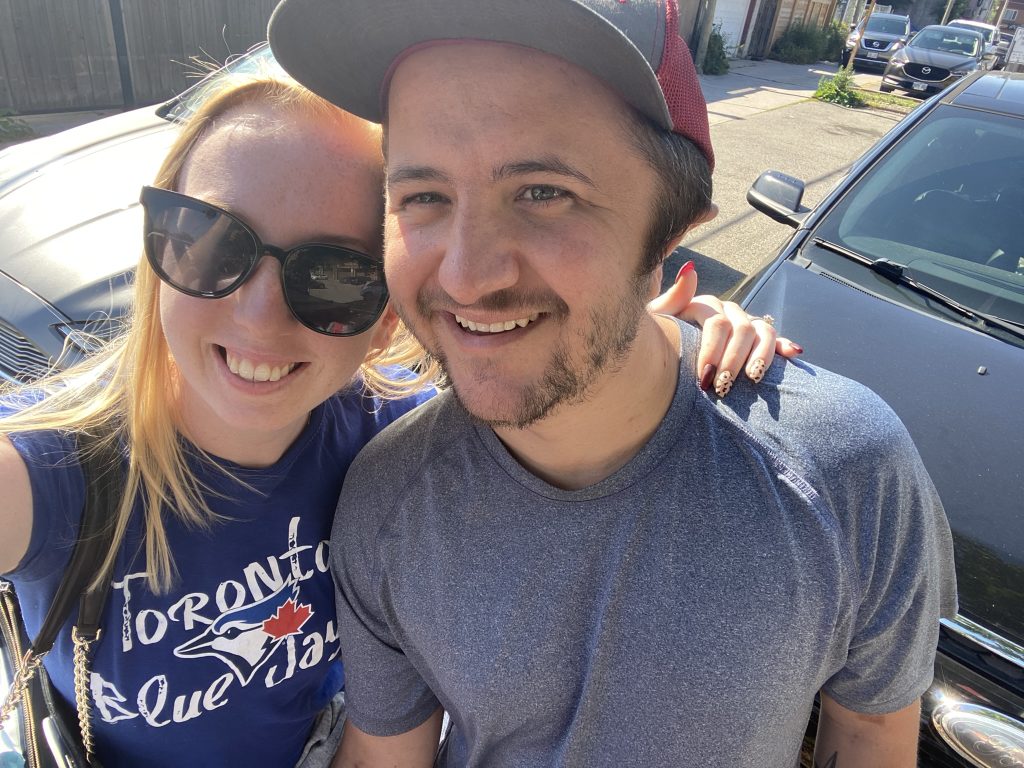
“They weren’t sure if he would wake up or what his function would be because the brain injuries were so extensive,” explains Alexandra.
It was a lot to process. Too much to process. Brandon was 30 and Alexandra 27. They were two years married, ready to start a family. In an instant, all her hopes were reduced to his survival and all her plans whittled down to his recovery. For 13 days following his surgery Brandon was on a ventilator and his condition remained stubbornly touch and go.
Finally, Brandon’s condition stabilized enough for his health care team to wake him up. Alexandra rushed to the hospital when she heard the news.
She was anxious. She had no idea what condition her husband’s mental and physical function would be. Would he be able to talk? Would he even remember who she was?
The answers to both of these questions were yes. Brandon’s speech was a bit garbled and he was confused about being in the hospital, but he immediately recognized Alexandra and tried to give her a hug.
Recovery and rehabilitation
Because Brandon and Alexandra lived out in the country, beyond the normal catchment area for The General’s Regional Rehabilitation Centre (RRC), Brandon was supposed to return to his local hospital system for rehabilitation.
But Alexandra wouldn’t hear it.
She works as a nurse in her region’s hospital and is quick to assert that it’s a fantastic hospital with excellent facilities and brilliant staff. But Brandon, she felt, needed much more than what her local county hospital could provide in order to have a shot at a meaningful recovery. With Brandon out of the woods, Alexandra has let her hopes and plans for a full and vibrant future with her husband grow and she was ready to do whatever it took to make that happen.
So, Alexandra fought to get Brandon into the Regional Rehabilitation Centre and she succeeded. She put every ounce of her formidable intelligence, time, effort and determination towards Brandon’s recovery. She attended every appointment, educated herself on all aspects of Brandon’s injury and the potential for management and improvement.
“Brandon has an amazing wife,” say Dr. Kachur, admiring Alexandra’s advocacy throughout Brandon’s recovery. “She’s extremely caring and concerned for her husband’s wellbeing. Anybody would want to have somebody like that if they got into a situation like Brandon did.”
At the RRC’s Acquired Brain Injury Unit, Brandon re-learned how to walk, how to chew and swallow. The therapy team helped him to get his strength and memory back, all while dealing with the emotional fallout and trauma from the accident.
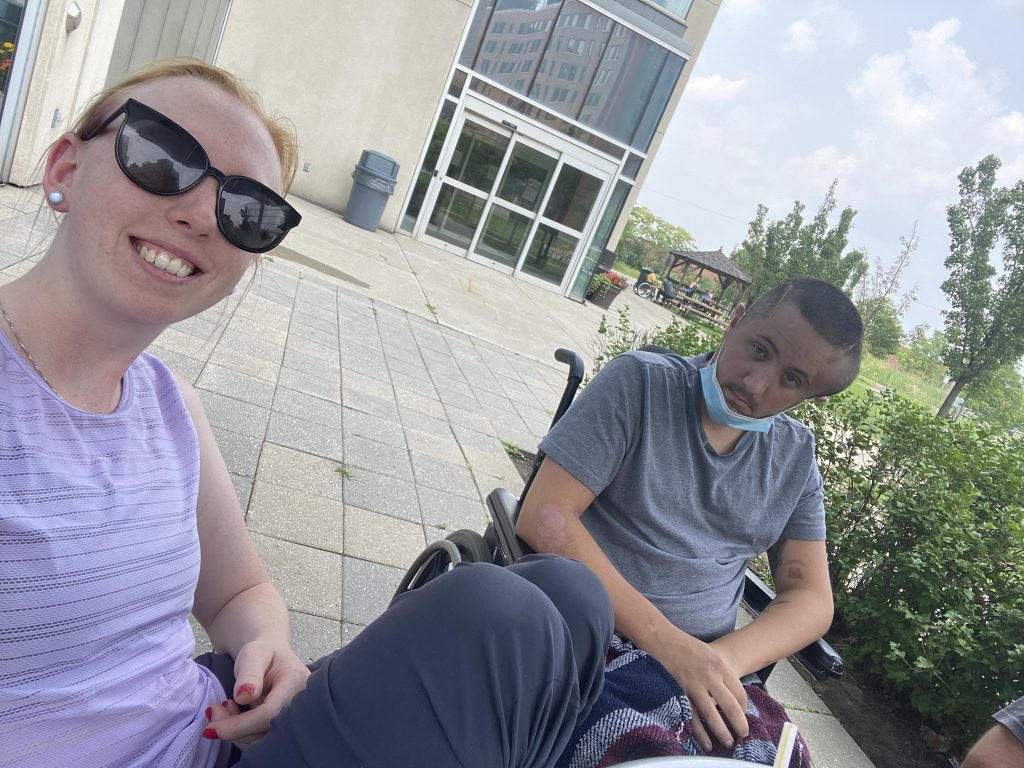
“They were amazing,” says Alexandra. “Especially his rehab assistant, Diana. She worked with him every day: going to the gym, helping him out. She was fantastic.”
Diana was also there to talk Alexandra through the hard days and “put Brandon in his place if he was getting a little saucy,” as Alexandra describes it, smirking. “He’d call be and be like, ‘you gotta bring the boss a coffee, I was rude today.’ ”
“They brought him back,” says Alexandra. “Dr. Kachur saved his life, but the rehab team gave me my husband back. I don’t think Brandon would be home with me [without the Regional Rehabilitation Centre]. I think he would probably be either not with us anymore or I’d either have to visit him at a cemetery or at a long-term care facility if they didn’t work so diligently with him.”
Both Brandon and Alexandra acknowledge that things will never be the same as before the accident. But Brandon has made significant recovery in all the ways that matter most to the couple.